
Buying guide
Best pergola for Arizona heat and monsoons
For most Phoenix yards, a powder-coated aluminum structure with a roof that can give full shade: a louvered pergola if you want to open it, an insulated patio cover if you don’t. Aluminum doesn’t warp or need restaining, and a louvered or insulated roof handles both July sun and monsoon rain. Whatever you choose, ask for its wind rating.
In the Phoenix metro: louvered pergolas from about $12,000, with a written quote before any work. Installation is done by a licensed Arizona contractor. Phoenix, Scottsdale, Mesa, Gilbert, Chandler. Call (602) 557-3625
Which pergola material lasts in Arizona?
| Material | In desert sun | Upkeep | Phoenix cost example |
|---|---|---|---|
| Powder-coated aluminum | Holds its color for about a decade | Rinse and clear the gutters | 12×16: $14,000–$22,000 |
| Wood | Bleaches and checks | Refinish every 2–3 years | 12×16: $8,000–$12,000 |
| Steel | Strong; needs a good coating | Watch for rust at scratches | Custom: $22,000–$45,000+ |
Arizona installers recommend aluminum or steel over wood for most Valley homes: wood looks good on day one, but the sun works on it every year. Quality powder-coated aluminum is made to resist UV fading and corrosion, which is what keeps its color in desert sun.
Which roof type is best for Phoenix heat?
| Roof | Shade | Rain | Best for |
|---|---|---|---|
| Louvered (also called bioclimatic or adjustable) | Adjustable, open to full | Closes and drains | Year-round use; pool decks |
| Insulated solid panels | Full, with less radiant heat | Keeps it out | All-day shade off the house |
| Solid aluminum panels | Full | Keeps it out | Rain cover on a budget |
| Open slats or lattice | Filtered, 50–80% | Doesn’t keep it out | Mild months; walkways |
| Retractable fabric canopy | Adjustable | Some fabrics shed light rain | Occasional shade you can pull back |

Choosing a pergola for monsoon season
Arizona’s monsoon season runs June 15 to September 30, and its storms bring downbursts, hail and strong straight-line winds. A National Weather Service meteorologist calls strong downburst winds “pretty common” during the season, and dust storms have pushed gusts past 60 mph across the Valley. So:
- Ask for the structure’s wind rating in writing, and whether the footings are engineered for it.
- On louvered roofs, follow the maker’s wind guidance: StruXure, for one, tells owners to keep the louvers open during strong wind.
- Check that gutters and downspouts can carry a monsoon downpour, and keep them clear.
- Choose motorized louvers with rain and wind sensors if nobody will be home when a storm hits.
Should louvered pergola blades be open or closed in a monsoon storm?
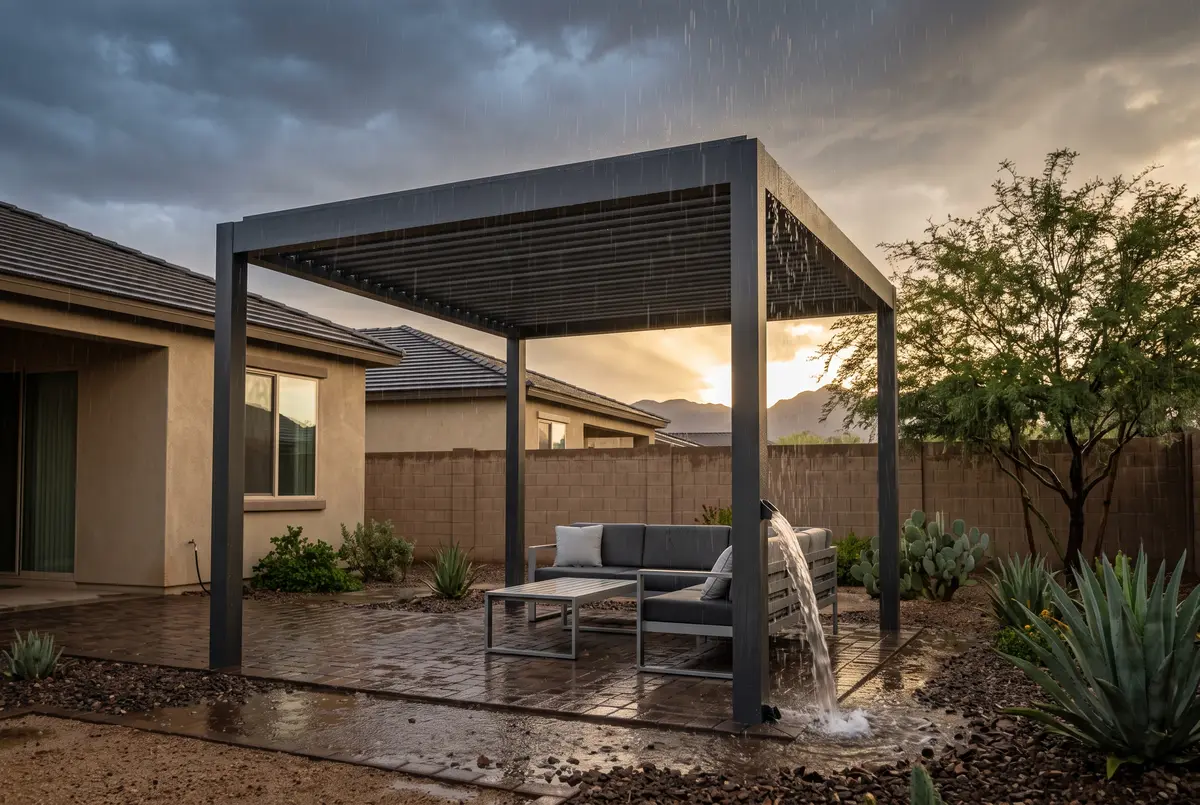
Louvered pergola owners should follow their system’s manual, because makers differ. StruXure tells owners to keep the louvers open during strong wind. Closed blades shed rain through the gutters in the frame, and opening them after a rain shower, as KE Outdoor Design recommends, helps clear water and dirt. Motorized systems with rain and wind sensors move the blades on their own, which matters when a storm arrives while nobody is home.
Retractable pergola canopies in Arizona
A retractable pergola uses a fabric canopy that slides open or closed on tracks, instead of rotating aluminum blades. Installed, retractable canopies run about $15–$50 per square foot, according to a Los Angeles installer’s 2026 pricing, below most louvered roofs; Palmiye sells retractable systems in the Phoenix metro. Fabric gives adjustable shade, but it is usually pulled back in high wind, so check the maker’s wind limits before counting on it in monsoon season.
Pergola brands sold in the Phoenix metro
Premium louvered systems sold through Valley dealers include StruXure, Renson and Equinox; Palmiye sells retractable systems; and Alumawood is the common brand for aluminum patio covers. Brands differ in blade design, wind and snow ratings, motors and warranties, so compare the spec sheets, not just the price. Premium brands typically run $120–$200 per square foot installed.
Which pergola fits each kind of yard
- Year-round patio or pool deck: a motorized louvered aluminum pergola (cost guide).
- All-day shade right off the house: an insulated aluminum patio cover (cost guide).
- Filtered shade on a budget: a fixed powder-coated aluminum pergola (cost guide).
- A shaded outdoor kitchen away from the house: a ramada (cost guide).
Sources
Prices are published figures, not quotes; checked September 29–30, 2026. Permit rules are paraphrased from each city’s own guidance, and they change, so the installer confirms them for your address.
Products, prices and weather
- AE Outdoor Living, Backyard Pergola Ideas That Survive Arizona Sun
- AE Outdoor Living, Pergola & Ramada Design in Phoenix
- AE Outdoor Living, Phoenix pergola pricing
- Royal Covers, Phoenix patio cover and pergola pricing
- Pergola Cave, Pergola Cost in Los Angeles (2026)
- EDG Patio Shade, Pergola Cost Guide 2026
- KE Outdoor Design, Pergola Maintenance
- StruXure, Care & Maintenance
- Arizona State University, Basics of the Arizona Monsoon
- National Weather Service Phoenix, 2019 Monsoon presentation
- Phoenix New Times, How rare was that destructive Tempe microburst
- Associated Press via Global News, Strong winds push massive dust cloud into Phoenix
Permit rules
- City of Phoenix, Work Exempt from Permit (PBCC 105.2)
- City of Phoenix, Residential Patio Covers Guideline
- City of Phoenix, Residential Over the Counter Permits Guideline
- City of Phoenix Historic Preservation Office, Approvals and Guidelines
- City of Scottsdale, Sheds, Detached Garages, Pergolas, etc.
- City of Scottsdale, Permit Services
- City of Mesa, Residential Construction FAQ
- City of Mesa, Residential Construction
- Town of Gilbert, Municipal Code & Land Development Code FAQ
- City of Chandler, Detached Buildings & Structures Chart (Jan 2025)